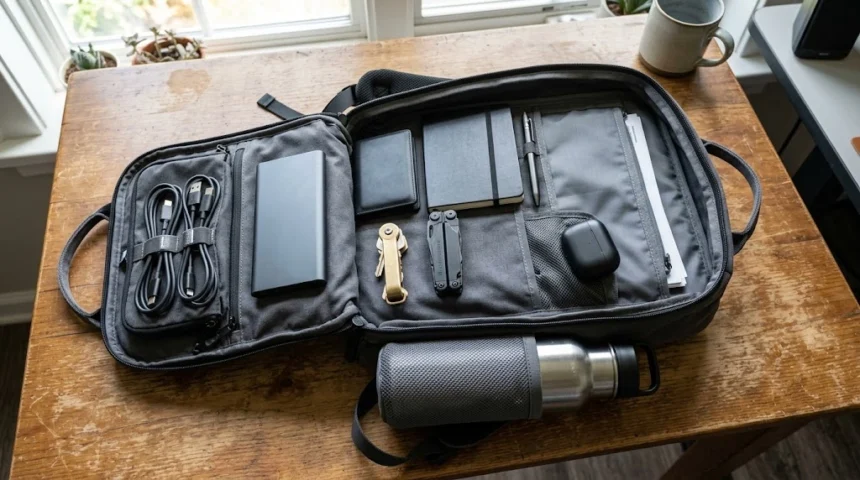
The best everyday carry items for a streamlined bag include a tech pouch for cables, a slim wallet, a compact key organizer, packing cubes, and a multi-tool. Together, these items group your gear by category, cut down on loose clutter, and make it easy to find what you need in seconds instead of minutes.
- Why Your Bag Feels So Messy
- Start With a Tech Pouch for Cables and Chargers
- Swap Your Bulky Wallet for a Slim One
- Tame Your Keys With a Compact Organizer
- Use an EDC Pouch for Your Small Essentials
- Add Packing Cubes If Your Bag Doubles for Travel
- Give Documents Their Own Flat Folder
- How to Actually Set Up Your System
- Common Mistakes That Undo Your System
- The Payoff of a Streamlined Bag
Why Your Bag Feels So Messy
You know the feeling. You reach into your bag for your keys, and instead you pull out a receipt, half a granola bar, and a tangle of charging cables. This happens because most bags start with good intentions and end up as a junk drawer.
Every item you toss in without a system adds friction to your day. You spend extra minutes searching. You forget things at home. You carry stuff you never use just because it’s already in there.
The fix isn’t a bigger bag. It’s a smarter one. When you assign every item a specific place, your bag stops working against you and starts working for you.
Start With a Tech Pouch for Cables and Chargers
If you carry a phone charger, a power bank, and a set of earbuds, you already know how fast cables turn into spaghetti. A dedicated tech pouch solves this instantly.
A small pouch works well for charging essentials, making it ideal for anyone who just needs a phone, a power bank, and a couple of cables. If you carry more gear, like a tablet or a compact laptop setup, a medium pouch gives you room for that equipment along with its accessories.
The real value of a tech pouch is that it travels with you. If your gear lives in a separate pouch, you can move it into whatever bag you decide to carry that day. No more transferring cables one at a time when you switch bags for a trip or a different commute.
Look for one with a few mesh pockets and an elastic loop or two. That way your charger doesn’t tangle with your earbuds, and you can see what’s inside without unzipping every compartment.
Swap Your Bulky Wallet for a Slim One
A thick wallet stuffed with old receipts and expired coupons takes up more room than it should, and it makes your bag lopsided. A slim travel-style wallet fixes that.
A travel wallet should hold your passport, boarding passes, one credit card, one debit card, foreign currency, and a pen. Everything else stays home. This same rule applies even when you’re not traveling. Keep the two or three cards you actually use, some cash, and your ID. Drop the loyalty cards you never scan and the punch cards from cafes you visited once.
The goal is quick access to what you need at every checkpoint, without digging through a wallet stuffed with items that don’t belong there. A slimmer wallet also fits flat in a bag pocket instead of bulging out and throwing off the balance of everything around it.
Tame Your Keys With a Compact Organizer
Loose keys are one of the biggest offenders when it comes to bag noise and bag damage. They jingle, they scratch your phone screen, and they poke holes in soft pouches.
A key organizer solves this by locking your keys into a flat, folded stack. A good key organizer can turn up to eight keys into something that looks more like a pocket knife than a keyring. Most models can accommodate up to eight flat standard-sized keys comfortably and securely, with room to expand if you need more.
This one swap does two things. It stops the jingling that makes your bag noisy, and it protects your phone screen and other items from getting scratched every time your keys shift around.
Use an EDC Pouch for Your Small Essentials
Beyond tech and keys, most people carry a handful of small items that need their own home: a pen, a multi-tool, a small flashlight, spare batteries, or a notebook. Tossed loose into your bag, these items sink to the bottom and disappear.
EDC pouches are purpose-built carry solutions engineered specifically to organize and accommodate daily gear. They typically open to reveal slips, loops, keepers, and pockets sized to fit standard everyday items like flashlights, pocket knives, pens, and key organizers.
A good pouch turns your pocket dump into a grab-and-go kit. One pouch means every tool gets a slot, and nothing stays loose. When everything has an assigned spot, you can feel with your hand and know instantly if something is missing, without pulling the whole bag apart on the sidewalk.
If you want something that also doubles as a light wallet, some pouches include card slots and a spot for cash, so you’re not managing two separate items.
Add Packing Cubes If Your Bag Doubles for Travel
If your everyday bag also comes out for weekend trips, packing cubes are worth adding to your rotation. Packing cubes are fabric compartments that compress and separate clothing inside a bag, and they’re worth it for almost every traveler because they reduce pack time, maximize space, and let you grab specific items without unpacking everything.
You don’t need a full travel set for everyday use. Even one small cube for a spare shirt, a change of socks, or gym clothes keeps soft items from sliding around and mixing with your tech gear or documents.
Choosing accessories that pack flat, without rigid frames that waste space, adds meaningful room inside your bag. This matters just as much for a daily commuter bag as it does for a carry-on suitcase.
Give Documents Their Own Flat Folder
Boarding passes, appointment printouts, or work documents tend to get bent, folded, or lost in the bottom of a bag. A slim document folder or a flat pouch dedicated to paper keeps them flat and easy to find.
This might seem like a small addition, but it removes one more category of item competing for space with your electronics and personal items. When paper has its own spot, it stops sneaking into your tech pouch or getting crushed under your water bottle.
How to Actually Set Up Your System
Buying organizers doesn’t help if you dump them all in and never assign them a purpose. Take ten minutes and empty your bag completely onto a table. Sort everything into categories: tech, documents, personal items, and anything you haven’t used in the last month.
That last category is important. If you haven’t touched an item in thirty days, it probably doesn’t need to live in your bag. Move it home or get rid of it. Assembling a full EDC is only half the battle — how you carry your gear matters just as much.
Once you’ve sorted, assign each organizer a fixed spot in your bag. Keep your tech pouch in the same pocket every single day. Keep your wallet and keys in the same spot every single day. Repetition builds a habit, and a habit means you stop thinking about where things are.
Common Mistakes That Undo Your System
Even with the right organizers, a few habits can quietly wreck your setup. The first is buying too many pouches at once. If you grab five different organizers in one shopping trip, you end up with overlapping systems and no clear rule for where anything goes. Start with one or two categories, get comfortable with them, then add more only if you still need them.
The second mistake is ignoring size. A tech pouch that’s too big for your actual gear leaves room for random items to creep back in, which defeats the purpose. Match the pouch size to what you truly carry every day, not what you might carry on a rare trip.
The third mistake is skipping the reset. Bags get messy again over time, even good ones. Set a weekly reminder to empty your bag, wipe out crumbs and dust, and put items back in their proper spot. Five minutes a week keeps the whole system running.
Finally, don’t forget to remove items on the way out, not just add them. If you picked up a spare charger cable for a one-time trip, take it back out once you’re home. A streamlined bag stays streamlined only if you treat it as a two-way process.
The Payoff of a Streamlined Bag
A well-organized bag isn’t about looking tidy. It’s about getting your day back. Research into daily habits shows that organization reduces stress and cuts the time spent searching or repacking, sometimes by as much as 40 percent.
Every extra second you spend hunting for keys or untangling a charger adds up over a week, a month, a year. A tech pouch, a slim wallet, a key organizer, and a small EDC pouch cost very little and take almost no time to set up. In exchange, you get a bag that hands you what you need the moment you need it.
Start with just one or two items from this list. Once you feel the difference, the rest of the system tends to fall into place naturally.