
Travelling around Australia sounds expensive — and for many people, that assumption stops the trip before it starts. But here’s the reality: Australia has some of the most accessible, genuinely affordable travel experiences in the Asia-Pacific region, if you know where to look.
- Why Australia Is More Affordable Than Most Travellers Think in 2026
- Top Budget-Friendly Destinations in Australia for 2026
- 1. Adelaide, South Australia — Big City Value Without the Big City Price Tag
- 2. Darwin, Northern Territory — Affordable Gateway to Kakadu and the Top End
- 3. Cairns, Queensland — Tropical Experiences on a Tight Budget
- 4. Margaret River, Western Australia — World-Class Scenery, Wallet-Friendly Options
- 5. The Blue Mountains, New South Wales — Day Trip or Weekend Getaway Under Budget
- 6. Hobart, Tasmania — Australia’s Most Underrated Budget City
- 7. Broken Hill, New South Wales — Off the Beaten Track and Genuinely Cheap
- Money-Saving Tips That Work Across All Budget-Friendly Destinations in Australia
- Holiday Parks, Hostels, and House-Sitting
- Getting Around Without Blowing the Transport Budget
- Eating Cheaply Without Eating Badly
- Best Times to Visit for Maximum Savings in 2026
- Budget Travel in Australia With Kids — What Families Need to Know
- The Best Destinations in Australia Are Waiting
Whether you’re planning a family road trip or heading off solo on a shoestring, the right destination makes all the difference. This guide walks you through the best budget-friendly destinations in Australia for 2026, with practical tips on where to sleep, eat, and explore without blowing your savings.
Why Australia Is More Affordable Than Most Travellers Think in 2026
The idea that Australia is “too expensive to travel” is outdated. Yes, Sydney and Melbourne can stretch a budget fast. But Australia’s geography means you’re never far from a free national park, an uncrowded beach, or a campsite that costs less than a café lunch.
The country’s budget travel infrastructure has grown significantly. Holiday parks now offer family cabins at competitive prices, hostel networks have expanded in regional areas, and domestic flight competition — particularly from carriers like Jetstar — keeps interstate travel costs manageable. Add in free museum days, community-run food markets, and some of the world’s best free beaches, and you’re working with a lot.
Expect to spend roughly $80–$120 per day as a solo traveller and $180–$250 per day for a family of four, depending on your accommodation and transport choices. That covers a bed, meals, and activities — not luxury, but not roughing it either. Self-catering and camping bring those numbers down noticeably. Set your expectations around these figures and the destinations below become very achievable.
Top Budget-Friendly Destinations in Australia for 2026
Here’s where your money goes furthest. These aren’t just cheap — they’re genuinely worth visiting.
1. Adelaide, South Australia — Big City Value Without the Big City Price Tag
Adelaide is one of the most underpriced capital cities in the world for what it offers. The city runs a free tram network through the CBD, which alone saves families a noticeable chunk on transport. Rundle Mall is a free afternoon in itself, and the Adelaide Central Market — one of the largest covered fresh produce markets in the Southern Hemisphere — is as much a cultural experience as a practical one.
The Adelaide Fringe, held in February and March, is the world’s second-largest arts festival. Many events are free or low-cost, with pay-what-you-can options throughout the programme.
- Accommodation: Budget hostels in the CBD start from around $30–$45 per night. Airbnb apartment options are competitive, often sitting below $120 per night for a self-contained space — useful for families who want to self-cater.
- Key budget tip: Adelaide’s BYO wine culture is real and widespread. Many restaurants allow you to bring your own bottle for a small corkage fee of $3–$8, cutting a high cost from dining out. A bottle from a Barossa cellar door runs $15–$25. That’s a fraction of what you’d pay for a restaurant pour elsewhere.
- Estimated daily cost: $75–$100 solo / $170–$210 family of four.

2. Darwin, Northern Territory — Affordable Gateway to Kakadu and the Top End
Darwin sits at the edge of one of Australia’s most extraordinary natural regions, and getting into that landscape doesn’t require a luxury tour budget. The Mindil Beach Sunset Market runs on Thursday and Sunday evenings during the dry season (April to October) — entry is free, and the food stalls are genuinely affordable, with most meals priced between $10–$15.
Litchfield National Park is around 100km south of Darwin and offers free swimming holes (Wangi Falls, Florence Falls) that rival any resort pool. A self-drive day trip there costs little beyond fuel.
- Accommodation: Budget camping at Litchfield starts from $10–$15 per night. Darwin has a solid hostel network, with dorm beds from $28–$40. For families, holiday park cabins offer the best value at $90–$130 per night.
- Key budget tip: Visit during the shoulder season (April and late September) rather than the peak dry season. Accommodation prices drop noticeably, and the weather is still excellent.
- Affordable access to Kakadu: Self-drive entry to Kakadu National Park costs $40 per person for a seven-day pass — far cheaper than packaged tours that can run $300+ per person per day.
3. Cairns, Queensland — Tropical Experiences on a Tight Budget
Cairns is a legitimate budget destination if you avoid the resort-packaged excursions. The Esplanade Lagoon is free to swim in and is right in the heart of town — a large, clean saltwater lagoon that families use all day without spending a cent.
Getting out to the Great Barrier Reef doesn’t have to cost $300+. Local operators like Ocean Freedom and Passions of Paradise run reef day trips starting from around $100–$130 per person, significantly below what resort-adjacent tours charge. The reef experience is comparable.
- Accommodation: Cairns has one of Queensland’s densest hostel markets. Dorm beds start from $25–$35. Self-contained holiday apartments suit families well, often available from $110–$150 per night off-peak.
- Key budget tip: Cairns itself is very walkable. The night markets along the Esplanade have cheap eats — $10–$15 meals are standard. Skip the restaurant strip near the harbour for the first night and start at the markets instead.
- Estimated daily cost: $85–$110 solo / $180–$220 family of four (excluding reef trips).
4. Margaret River, Western Australia — World-Class Scenery, Wallet-Friendly Options
Margaret River’s reputation as a premium wine and food destination puts people off. The reality: you can spend a day exploring some of Australia’s best coastline, visit six cellar doors for free tastings, and pick up locally grown produce at the Margaret River Farmers Market (Saturday mornings, $2–$5 per item) without spending much at all.
The beaches here — Surfers Point, Prevelly, Gnarabup — are free, uncrowded outside peak summer, and genuinely spectacular. The Cape to Cape Track also has no entry fee.
- Accommodation: Budget camping at Boranup Campground (Leeuwin-Naturaliste National Park) runs around $12–$15 per night. For families, self-contained cottages outside the town centre are often more affordable than in-town options, especially midweek.
- Key budget tip: Shoulder season (March to May and September to November) drops accommodation prices by 20–30% compared to peak summer. The weather stays excellent in both windows.
- Estimated daily cost: $70–$90 solo with camping / $150–$200 family self-catering.
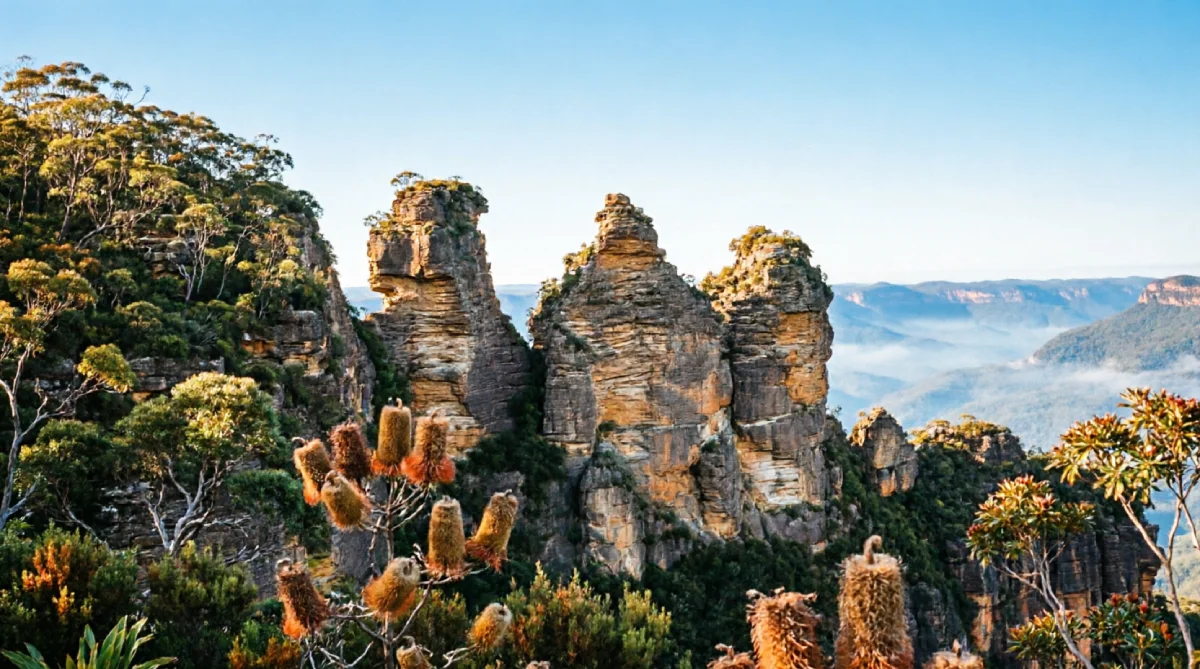
5. The Blue Mountains, New South Wales — Day Trip or Weekend Getaway Under Budget
The Blue Mountains is one of the best-value destinations in the country for travellers based in or passing through Sydney. A return train from Central Station to Katoomba costs around $10–$15 on an Opal card — no car required.
Echo Point, the Three Sisters lookout, and the Grand Canyon Walking Track are all free. A full day of hiking and sightseeing in the mountains costs almost nothing if you pack your own food.
- Accommodation: Guesthouses and older-style B&Bs in Katoomba and Leura offer rooms from $90–$130 per night — reasonable for a weekend away. For families wanting a longer stay, self-contained cottages start around $150–$180.
- Key budget tip: Avoid school holiday periods. The mountains get crowded, and prices climb. A mid-week visit in autumn (March to May) gives you the best foliage, quieter tracks, and lower accommodation prices simultaneously.
- Estimated daily cost: $60–$80 solo day trip from Sydney, / $100–$140 overnight solo.
6. Hobart, Tasmania — Australia’s Most Underrated Budget City
Hobart has quietly become one of Australia’s most interesting cities, and it’s still priced like a regional town in many respects. The Salamanca Market runs every Saturday morning and is free to browse — local produce, craft, and street food at very reasonable prices.
MONA (Museum of Old and New Art) offers free entry for Tasmanian residents and for children under 18 from anywhere in Australia. For interstate adults, entry is $38 — worthwhile, but plan around it. Ferrying across to MONA from Hobart’s waterfront on the MR-1 ferry costs $28 return and is a good value experience in itself.
- Accommodation: Hobart has a growing hostel market, with beds from $30–$45. Farm stays and self-contained cottages in the Huon Valley and Derwent Valley — 30–60 minutes from the city — offer excellent value at $100–$160 per night and connect well with produce tourism.
- Key budget tip: Autumn and winter (March to August) are Hobart’s shoulder seasons. Accommodation prices drop, Dark MOFO (a free-to-partially-free winter arts festival) runs in June, and the city has a noticeably quieter, more local feel.
- Estimated daily cost: $80–$100 solo / $170–$210 family of four.
7. Broken Hill, New South Wales — Off the Beaten Track and Genuinely Cheap
Broken Hill is for the road trippers and solo travellers who want something different. It’s one of the cheapest places to eat and sleep in Australia, with pub meals running $15–$22 and motel rooms from $70–$90 per night. The cost of living in this outback city is reflected directly in what visitors pay.
The scenery is free. Red earth plains, the Living Desert Sculpture Symposium (sculptures on a hilltop, no entry fee), and the White Cliffs drive (around 100km north) give you genuine outback Australia without a tour price attached.
- Key budget tip: Broken Hill works best as part of a broader road trip — pair it with Mungo National Park (entry $8 per vehicle) or use it as a stopover on the Silver City Highway. It’s not a destination for beach holidays, but for solo travellers and couples who want authenticity and low costs, it delivers both.
- Estimated daily cost: $55–$75 solo, making it one of the lowest-cost destinations on this list.
Money-Saving Tips That Work Across All Budget-Friendly Destinations in Australia
Holiday Parks, Hostels, and House-Sitting
- Big4 Holiday Parks offer powered campsites from $35–$45 per night and family cabins from $90–$130. They’re consistent, clean, and widely distributed across regional Australia.
- House-sitting platforms like TrustedHousesitters ($169 AUD annual membership) give families and solo travellers free accommodation in exchange for looking after a home and pets. For longer trips, it pays for itself quickly.
- Van hire through companies like Jucy or Mighty Campervans starts from around $60–$85 per day. It combines transport and accommodation into one cost — a smart move for destinations like Margaret River or the Top End, where self-driving is the best way to travel.
Getting Around Without Blowing the Transport Budget
- Jetstar domestic routes connect most capital cities and major regional hubs. Book 6–8 weeks ahead for the best prices. Melbourne–Hobart and Sydney–Cairns are often under $100 one-way.
- Greyhound coach passes suit solo travellers covering long distances along the eastern seaboard. A 365-day hop-on pass starts around $649 — good value if you’re moving frequently.
- National park annual passes (around $99–$199, depending on the state) are worth buying if you plan to visit more than three or four parks in one state. NSW, WA, and NT each offer their own pass programmes.
Eating Cheaply Without Eating Badly
- IGA and Aldi are your friends for self-catering. Even in remote areas, IGA branches stock the basics. Aldi has strong coverage in capital cities and larger regional towns.
- RSL club meals are a consistently underrated option. Most RSL clubs offer two-course meals for $15–$22, with no membership required for visitors.
- Food court culture in major cities (especially Adelaide’s Central Market, Melbourne’s Queen Victoria Market, and Brisbane’s South Bank) lets you eat well for $10–$15 a meal.
- BYO restaurants — common in Adelaide, Sydney, and Melbourne — cut beverage costs significantly. A $15 bottle of wine from a supermarket beats a $55 restaurant pour.
Best Times to Visit for Maximum Savings in 2026
Timing your trip around shoulder seasons is one of the most effective ways to cut costs. Here’s a quick regional guide:
- Queensland (Cairns, Whitsundays): Visit May–June or September–October. Winter is dry season — great weather, lower prices than peak, and fewer crowds than school holidays.
- South Australia (Adelaide, Barossa): March–May and September–October. Autumn and spring offer excellent weather and lower accommodation rates than the summer peak.
- Tasmania (Hobart): March–May for autumn foliage and low prices. June for Dark MOFO if you don’t mind cool weather.
- Western Australia (Margaret River): March–May and September–November consistently offer the best combination of weather, price, and crowd levels.
- New South Wales (Blue Mountains, Broken Hill): Avoid NSW school holidays entirely — they affect pricing across the entire state. March and September are reliable low-cost windows.
Australian school holiday dates vary by state and are published by each state education department in early January. Build your travel dates around them if you’re travelling without children.
Budget Travel in Australia With Kids — What Families Need to Know
Families travelling on a budget have a genuine advantage in Australia: children’s entry is free or heavily discounted at most national parks and many state museums. The South Australian Museum, Queensland Museum, and Museum Victoria all offer free general admission. Most national park day-use areas have no per-person charge beyond the vehicle entry fee.
Practical family tips:
- Self-contained apartments over hotel rooms. The ability to prepare even two meals a day in a kitchen cuts daily food costs by 30–40% for a family of four.
- Adelaide + Barossa as a family combo works well. Free tram, free museum, affordable self-drive wine region within 45 minutes. You can do three days in Adelaide and two in the Barossa Valley for well under $1,200 total in accommodation and activities.
- Road trips give families the most control over costs. You choose when to stop, where to eat, and how long to stay. Destinations like Margaret River, the Blue Mountains, and Litchfield National Park are all set up for self-drive family travel.
- Campervans suit families with children over six. Below that age, sleeping logistics become complicated. For families with primary school-aged kids and above, a campervan trip through the Top End or along the Great Ocean Road is one of the highest-value travel options available.
The Best Destinations in Australia Are Waiting
Australia’s best travel experiences aren’t locked behind premium price tags. Adelaide feeds you well and entertains you cheaply. Darwin hands you access to one of the country’s great wilderness regions for the cost of a national park pass. Hobart surprises people every single time.
Pick two or three destinations from this list, plan around shoulder seasons, and use the accommodation and transport tips above to stretch your budget further. The earlier you book accommodation and flights, the more room you have to move.
Your next step: Shortlist two destinations from this guide, check current accommodation prices for your travel window, and lock in flights early. The savings are real — you just have to plan for them.
Did this guide help you plan your trip? Share it with someone who needs a budget travel nudge — or drop your own Australian budget travel tips in the comments below.