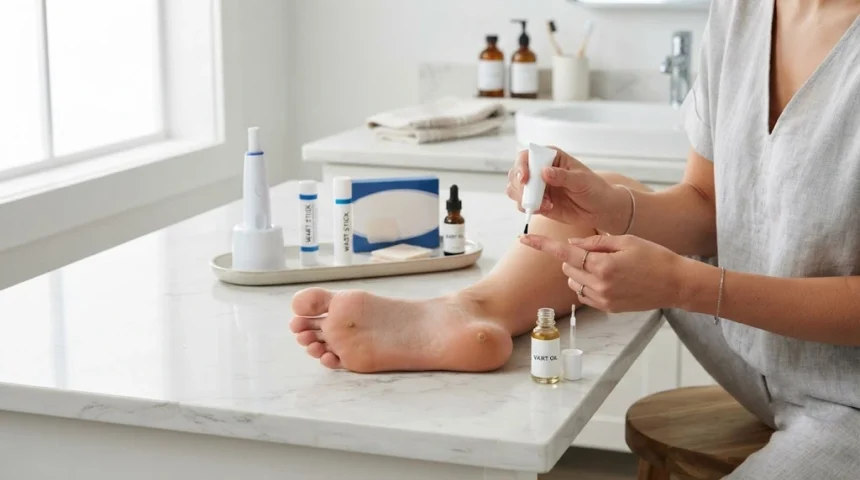
Warts are annoying. They show up on your hands, feet, and fingers without warning, and they can stick around for months. The culprit is usually a strain of human papillomavirus (HPV), which causes skin cells to grow faster than normal.
- How At-Home Wart Removal Actually Works
- 1. H-Warts Formula
- 2. Compound W Wart Remover Gel
- 3. Dr. Scholl’s Freeze Away Wart Remover
- 4. WartStick Maximum Strength Wart Remover
- 5. Curad Mediplast Wart Pads
- 6. Bazuka Extra Strength Gel
- 7. Wartner Cryotherapy Wart Remover
- How to Choose the Right Wart Remover for You
- Final Thoughts
The good news? Most warts go away on their own eventually. The not-so-good news? “Eventually” can mean waiting a long time. That’s why so many people turn to at-home wart removal products instead of just waiting it out.
In this guide, we’re breaking down seven of the most talked-about wart removers on the market. We’ll look at how each one works, what makes it different, and who it might be a good fit for.
How At-Home Wart Removal Actually Works
Before picking a product, it helps to understand the two main ways wart removers work.
Chemical exfoliation is the most common method. These products use salicylic acid to slowly soften and break down the layers of hardened skin that make up a wart. It’s not instant — most treatments need daily use over several weeks.
Cryotherapy, or freezing, takes a different approach. These kits use a cold spray to freeze the wart tissue, causing it to blister and eventually fall off. It’s the same basic idea a dermatologist uses in-office, just in a smaller, at-home version.
There’s also a third, smaller category: natural and oil-based formulas. These skip the acid and cold altogether, relying on plant-based ingredients instead. They tend to appeal to people who want a gentler option, even if results can take longer to show.
No single method works the same way for everyone. Wart size, location, and how consistent you are with treatment all play a role in how fast you’ll see results.
1. H-Warts Formula
H-Warts Formula is a homeopathic oil blend built around botanical ingredients rather than acid or freezing agents. It’s applied topically and is designed to work with the skin’s own healing process over time.
This one tends to appeal to people who specifically want to avoid harsher treatments. Like most natural wart remover options, results can vary quite a bit depending on the wart’s size and how long it’s been there. It’s also been around long enough to build a loyal following in the natural skincare space.
Best for: People who prefer a plant-based approach over acids or freezing.
2. Compound W Wart Remover Gel
Compound W is one of the most recognizable names in wart care, and for good reason — it’s been on drugstore shelves for decades. The Compound W wart gel uses salicylic acid to gradually break down wart tissue with repeated use.
Part of its popularity comes down to simplicity. It’s easy to find, easy to apply, and the instructions are straightforward, which matters when you’re treating something at home without professional guidance. It’s commonly used on common warts that appear on the hands and fingers.
Best for: First-time users who want a trusted, widely available option.
3. Dr. Scholl’s Freeze Away Wart Remover
Freeze Away brings the cryotherapy approach into your bathroom cabinet. It uses a handheld applicator to deliver a freezing treatment directly to the wart, mimicking what you’d get at a dermatologist’s office.
One advantage of freezing treatments is speed — they often require fewer applications than acid-based products. That said, the freezing sensation can be uncomfortable, especially on sensitive skin, so it’s worth reading the instructions closely before starting.
Best for: People who want faster results and don’t mind a bit of discomfort.
4. WartStick Maximum Strength Wart Remover
WartStick is another salicylic acid product, but it comes in a solid stick format instead of a gel or liquid. That makes it easy to apply precisely, without the mess or waste that sometimes comes with liquid treatments.
Like other acid-based products, this one requires patience. It’s not a one-time fix — consistent daily use over several weeks is usually what gets results. Its portability makes it a popular pick for people who want to travel with their treatment or keep it in a bag.
Best for: On-the-go application and precise, mess-free treatment.
5. Curad Mediplast Wart Pads
Curad Mediplast takes a patch-based approach. Instead of applying gel or liquid each day, you stick an adhesive pad containing salicylic acid directly over the wart and leave it in place.
This continuous-contact method is especially popular for plantar warts, which appear on the soles of the feet and are often covered by thicker skin. Because the pad stays on throughout the day, the active ingredient has more time to work between applications.
Best for: Plantar warts and thicker areas of skin.
6. Bazuka Extra Strength Gel
Bazuka Extra Strength Gel combines an active treatment ingredient with a protective film that forms over the wart after it dries. That film helps keep the product in place and shields the area from friction throughout the day.
People often compare Bazuka wart treatment against other salicylic acid gels when weighing ease of use and overall convenience. The protective barrier is one of its more distinctive features compared to standard gels.
Best for: People who want extra protection built into the treatment.
7. Wartner Cryotherapy Wart Remover
Wartner Cryotherapy is another freezing-based option, similar in concept to Freeze Away. It’s designed for people who want a direct cryotherapy wart removal approach without acid-based products.
Because freezing and chemical treatments work so differently, many people end up choosing between the two based purely on comfort and personal preference rather than one being objectively “better.” Wartner shows up frequently in product comparisons thanks to its wide availability.
Best for: Comparing freezing kits side by side with other cryotherapy products.
How to Choose the Right Wart Remover for You
With so many options, picking one comes down to a few key factors:
- Location of the wart — pads work well for feet, while gels and sticks suit hands and fingers.
- Skin sensitivity — natural formulas may suit sensitive skin better than acid or freezing treatments.
- Comfort with discomfort — freezing kits can sting, while acid treatments are usually milder but slower.
- Consistency — acid-based products need daily use over weeks; freezing kits often need fewer applications.
There’s no universal “best” option here. What works quickly for one person might take much longer for another, depending on the wart itself and how consistently the treatment is used.
If a wart is painful, changes in appearance, bleeds, or doesn’t respond to home treatment after several weeks, it’s worth checking in with a dermatologist rather than continuing to self-treat. The American Academy of Dermatology has educational resources on wart causes and treatment that are worth a look for anyone wanting a deeper understanding of the condition.
Final Thoughts
At-home wart removers come in a lot of different forms — gels, sticks, adhesive pads, freezing kits, and natural oils. Each one takes a different route to the same goal, and the “right” choice really depends on your skin, your wart, and your patience level.
Whether you lean toward a classic salicylic acid gel, a freezing kit that mimics an in-office treatment, or a gentler natural formula, sticking with the treatment consistently is what tends to make the biggest difference in the end.
For more helpful guides and product comparisons, keep exploring Mashmagazine.com.au.