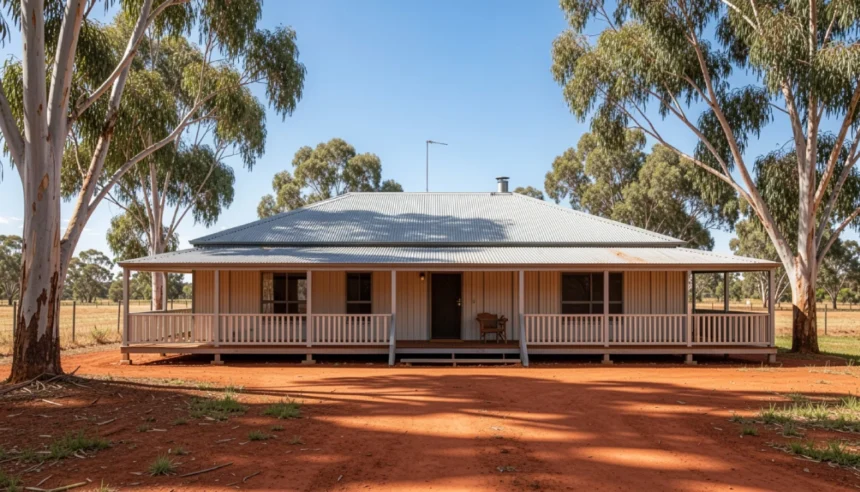
With new home construction costs across Australia pushing past $2,500 per square metre, more landowners and rural property buyers are asking whether there’s a smarter way to build. A barndominium Australia build could be the answer — offering generous space, strong steel-frame construction, and a significantly lower cost per square metre than a conventional brick veneer home.
- What Is a Barndominium in Australia?
- How Much Does a Barndominium Cost in Australia? (2026 Breakdown)
- Are Barndominiums Legal in Australia? Council Approvals Explained
- Do You Need a Development Application (DA) or Building Approval (BA)?
- Key Building Codes That Apply to Barndominiums
- Barndominium Kits Australia — What’s Available and What to Look For
- Barndominium Floor Plans — Popular Layouts for Australian Properties
- How to Build a Barndominium in Australia — Step-by-Step Process
- Step 1 — Site Selection and Zoning Check
- Step 2 — Engage a Draftsperson or Designer
- Step 3 — Lodge Your DA or Building Approval
- Step 4 — Select Your Builder or Go Owner-Builder
- Step 5 — Construction Sequence
- Can You Get a Home Loan for a Barndominium in Australia?
- Pros and Cons of Building a Barndominium in Australia
- Real-World Example — What a $350,000 Barndominium Looks Like in Regional Australia
- Conclusion
Whether you own acreage in regional Queensland, a lifestyle block in rural Victoria, or a semi-rural lot in Western Australia, this guide covers everything you need to make an informed decision. From full cost breakdowns and barndominium floor plans to council approvals, financing, and the step-by-step building process, you’ll find practical, Australia-specific guidance here — not theory.
If you’ve been comparing a barndominium vs a traditional house in Australia, or wondering whether a barn house Australia build is even legal, read on.
Let’s break it all down.
What Is a Barndominium in Australia?
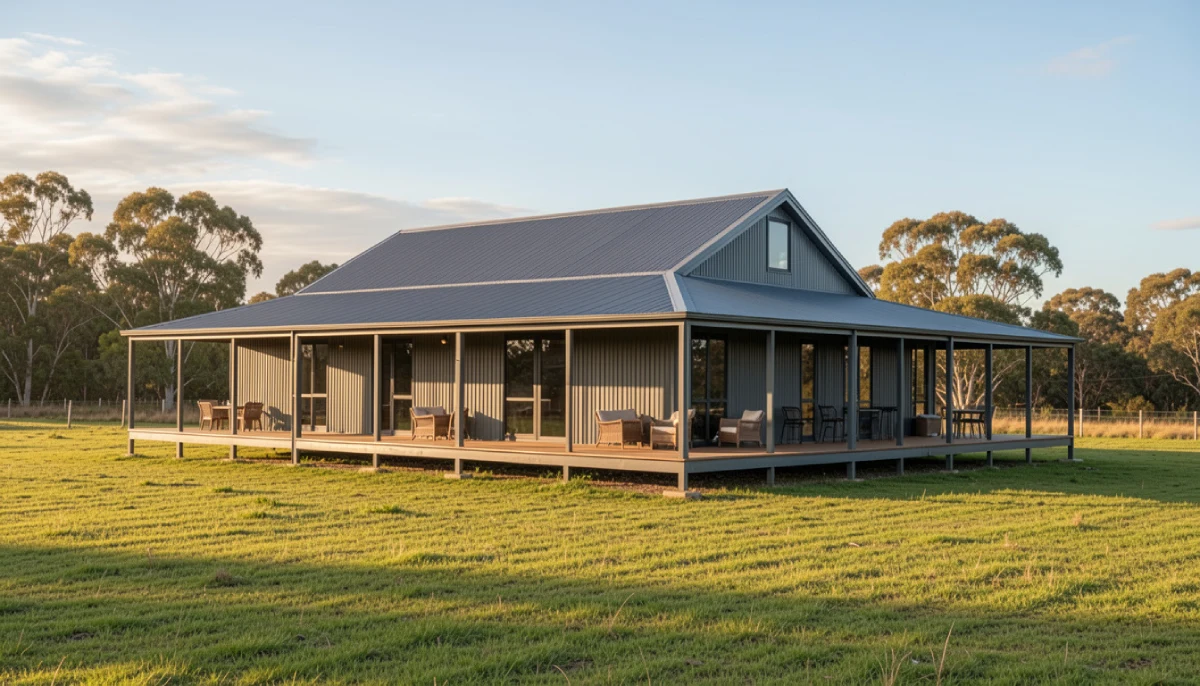
A barndominium — sometimes called a barn house or shed house in Australia — is a steel-frame structure that combines a residential living area with an open-span interior, typically under a single large roof. Think of it as a high-clearance, open-plan home built using the same structural approach as a commercial shed, but finished to a full residential standard inside.
The term “barndominium” originated in the United States, but the concept has gained real traction across rural and regional Australia — particularly in Queensland, New South Wales, Victoria, and Western Australia — where large land parcels and agricultural lifestyles make integrated living-and-working spaces highly practical.
Barndominium vs Shed Home vs Kit Home — What’s the Difference?
These three terms get used interchangeably in Australia, but they’re not the same thing:
- Barndominium: A steel-frame structure designed and built as a full residential dwelling from the outset. It follows the National Construction Code (NCC) and is approved as a Class 1a home.
- Shed home: Often refers to an agricultural or commercial shed that has been converted into living quarters. This category sits in a legal grey area — many converted sheds don’t comply with residential building codes and can create significant problems with council, insurance, and resale.
- Kit home: A prefabricated residential package — steel-frame or timber — supplied in components and assembled on site. A barndominium kit is a specific type of kit home using a wide-span steel frame system.
Tip: Before you buy land or speak to a builder, establish which category your project falls into. If you want council approval and a legitimate Certificate of Occupancy, your build must meet NCC Class 1a residential requirements — regardless of what it looks like from the outside.
How Much Does a Barndominium Cost in Australia? (2026 Breakdown)
This is the question most Australians want answered before anything else — and it’s also where the most confusion exists. Broad estimates circulating online range from $150,000 to well over $600,000. The truth is, both figures can be accurate depending on size, finish, location, and whether you’re a building owner-builder or using a licensed contractor.
As a realistic benchmark for 2026, expect a completed, liveable barndominium in Australia to cost between $180,000 and $550,000+, depending on those variables.
Here’s a full cost breakdown across three finish levels:
| Cost Component | Budget Finish | Mid-Range | High-End |
|---|---|---|---|
| Land preparation & site works | $10,000–$25,000 | $25,000–$50,000 | $50,000+ |
| Concrete slab | $20,000–$35,000 | $35,000–$55,000 | $55,000–$80,000 |
| Steel shell/kit supply | $40,000–$80,000 | $80,000–$130,000 | $130,000–$200,000 |
| Interior fit-out | $50,000–$90,000 | $90,000–$150,000 | $150,000–$250,000 |
| Plumbing & electrical | $20,000–$35,000 | $35,000–$55,000 | $55,000–$80,000 |
| Council fees & permits | $3,000–$8,000 | $8,000–$15,000 | $15,000–$25,000 |
| Total Estimate | ~$143K–$273K | ~$273K–$455K | $455K–$685K+ |
Note that these figures exclude land purchase costs, which vary enormously by region.
Cost per Square Metre — Barndominium vs Traditional House
One of the strongest arguments for a barndominium in Australia is the cost per square metre comparison:
| Build Type | Approx. Cost per m² |
|---|---|
| Barndominium (budget–mid) | $1,100–$1,800/m² |
| Project home | $1,800–$2,500/m² |
| Brick veneer (custom) | $2,200–$3,500/m² |
| Architecturally designed home | $3,500–$6,000+/m² |
The gap narrows at the high-end finish level, where barndominium interiors approach conventional home costs. But at the shell and structural stage, the steel-frame approach consistently comes in cheaper — often by 20–40% compared to a standard build of the same footprint.
What Affects the Final Price?
Five factors drive the biggest cost swings:
- Location and site access — building in remote outback WA or far north Queensland adds significant freight and labour costs. A regional VIC or southern NSW site is generally cheaper to service.
- Size and floor plan complexity — a simple rectangular footprint is far cheaper than an L-shaped or multi-level design.
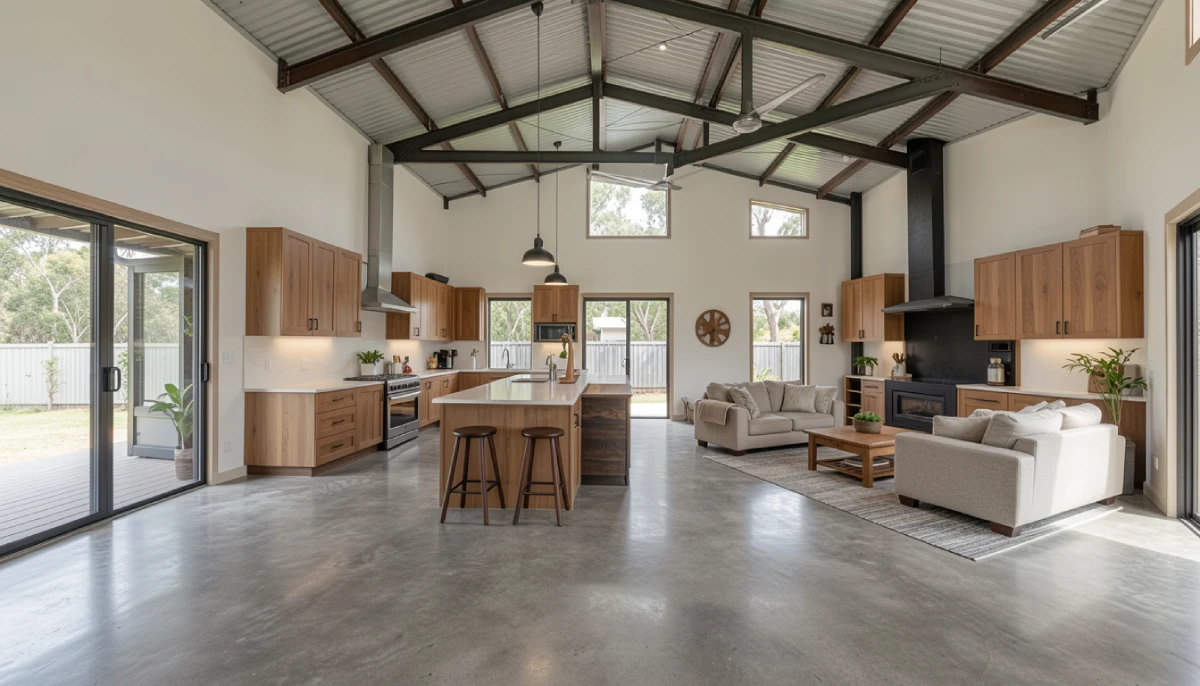
- Finish level — polished concrete floors and exposed steel beams are affordable; imported stone benchtops and imported joinery are not.
- Owner-builder vs licensed builder — owner-builders can save 15–30% on labour but take on greater responsibility, risk, and time investment.
- Regional labour costs — trades in regional areas can be scarcer and more expensive than metro fringe areas. Always get local quotes.
Are Barndominiums Legal in Australia? Council Approvals Explained
Yes — barndominiums are completely legal in Australia, provided they are designed, approved, and built to NCC Class 1a residential standards. The challenge is not legality; it’s zoning and the approval process, which varies by state and local government area (LGA).
Rural and semi-rural zoned land is generally where barndominiums are most straightforward to approve. Residential zoned land in urban fringe areas may have stricter design controls that work against an industrial-looking structure.
Golden rule: Contact your local council’s planning department before you purchase land for a barndominium project. Don’t assume approval.
Do You Need a Development Application (DA) or Building Approval (BA)?
The pathway depends on your state and the specific characteristics of your build:
- Queensland: A private building certifier can assess and approve a Class 1a barndominium under the Building Act 1975. A Development Application through the council may still be needed for land use planning approval in certain zones.
- New South Wales: A Complying Development Certificate (CDC) through a private certifier is available for straightforward builds that meet the State Environmental Planning Policy (Housing). If the site or design doesn’t meet CDC criteria, a full DA to the council is required.
- Victoria: A Building Permit issued by a registered Building Surveyor is the primary pathway. Planning permits from the council may also be required, depending on the zone and overlays.
- Western Australia: A Building Permit is required through a registered builder. In some rural shires, a planning approval may also be needed.
Tip: Engage a town planner or building consultant with barndominium experience early in your project. This is one of the most common points where first-time barndominium builders waste time and money.
Key Building Codes That Apply to Barndominiums
Your barndominium must comply with the same codes as any residential dwelling:
- NCC Volume 2 (Class 1a): Sets out structural, thermal, and habitability requirements for residential buildings.
- BAL (Bushfire Attack Level) rating: Applies to any property in a designated bushfire-prone area. This affects cladding, window, and door specifications — and can add $10,000–$40,000+ to build costs depending on your BAL rating.
- Energy efficiency (NatHERS / Section J): All new residential builds must meet a minimum 7-star NatHERS rating. Good insulation selection is critical in a steel-frame structure, which can experience significant thermal bridging without proper treatment.
- Cyclone rating: Properties in northern QLD and coastal WA require engineering to withstand cyclonic wind loads. Ensure your steel kit supplier engineers for the correct wind region.
Barndominium Kits Australia — What’s Available and What to Look For
The barndominium kits Australia market have grown considerably over the past five years. You’ll find a range of suppliers offering steel-frame residential shell packages — from basic Colorbond shed-style structures to fully engineered wide-span portal frame systems designed specifically for residential use.
Broadly, suppliers fall into two categories:
- Steel frame kit suppliers: These companies supply the structural steel, roofing, cladding, and sometimes windows and doors. You manage the trades, council approval, slab, and interior fit-out separately. Best suited to experienced owner-builders or those working with a builder who project-manages trades.
- Turnkey barndominium builders: These builders handle the full project — design, council approval, construction, and handover. You pay a premium, but the process is managed end-to-end. A growing number of builders across QLD, NSW, and VIC now specialise in this space.
When comparing kit suppliers, check these five things:
- Is the frame engineered for NCC Class 1a residential? (Not just commercial shed grade)
- Does the engineering include your wind region, BAL rating, and soil classification?
- What is included in the kit price — and what isn’t?
- What warranties apply to the steel frame and cladding?
- Can they provide engineering certificates for your building approval submission?
Kit Home vs Custom Build — Which Is Better for Your Budget?
| Kit Home (Owner-managed) | Custom Build (Licensed builder) | |
|---|---|---|
| Cost | Lower supply cost; you manage trades | Higher overall cost; builder margin applies |
| Control | High — you choose every trade | Lower — the builder makes many decisions |
| Risk | Higher — you’re responsible for coordination | Lower — builder carries most risk |
| Timeline | Flexible but often slower | More structured; the builder manages the schedule |
| Best for | Experienced owner-builders | First-time builders; busy professionals |
| Council process | The owner manages approval | A builder typically handles approval |
Recommendation: If you have building or project management experience, the kit home path can save $50,000–$120,000 on a mid-range build. If this is your first build, the time, stress, and risk of getting it wrong often make a turnkey builder the better investment.
Barndominium Floor Plans — Popular Layouts for Australian Properties
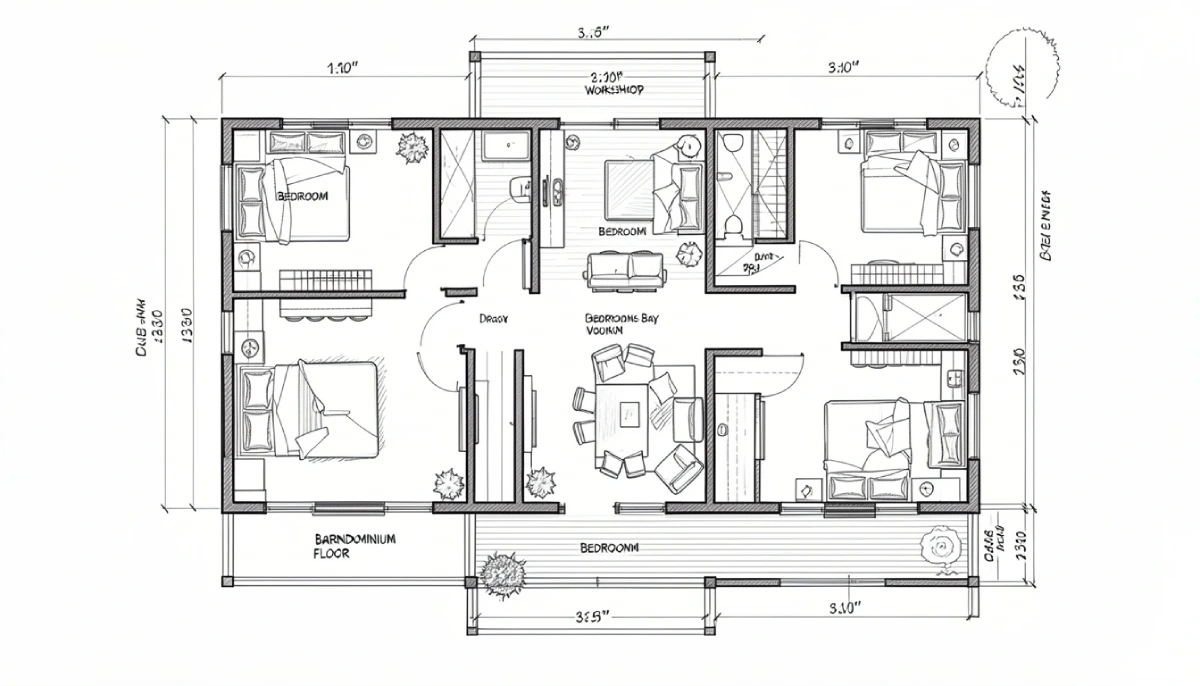
One of the most appealing aspects of a barndominium is the flexibility of the floor plan. The wide-span steel frame eliminates internal load-bearing walls, giving you enormous freedom in how you configure the interior space.
The most popular barndominium floor plans in Australia combine open-plan living with an integrated garage or workshop bay — a configuration that suits rural and lifestyle properties perfectly.
Common Sizes and What They Cost
| Size | Footprint | Approx. Shell Cost | Approx. Finished Cost (mid) |
|---|---|---|---|
| Small | 10 x 15m (150m²) | $55,000–$80,000 | $220,000–$320,000 |
| Medium | 12 x 18m (216m²) | $80,000–$110,000 | $300,000–$420,000 |
| Large | 15 x 24m (360m²) | $120,000–$160,000 | $420,000–$600,000+ |
These figures are indicative of a single-storey rectangular structure with standard Colorbond roofing and cladding.
Design Features That Work Well in Australian Conditions
- Overhanging verandahs (minimum 1.8–2.4m): Essential for passive shading in QLD, NT, and WA climates. They dramatically reduce solar heat gain through west- and north-facing walls.
- High-clearance ceilings (4.5–6m): Improve airflow and make the space feel far larger. Popular for open-plan living and workshop bays.
- Insulated roof and wall panels: Crucial in a steel-frame build. PIR or EPS insulated sandwich panels are a cost-effective way to meet NatHERS requirements and control temperature.
- Integrated workshop or machinery bay: A defining feature of the barndominium style — separate the living area from the workshop with a fire-rated wall, and you retain the residential classification.
- Passive solar orientation: Position the main living area to face north. Eaves and overhangs are sized to allow winter sun penetration but block summer sun.
How to Build a Barndominium in Australia — Step-by-Step Process
Step 1 — Site Selection and Zoning Check
Before you sign a contract on any rural or semi-rural land, confirm two things: (1) the zone allows a residential dwelling, and (2) there are no overlay constraints — flood, bushfire, heritage, or environmental — that would prevent or significantly complicate your build. Request the planning certificate (s10.7 in NSW, a planning report in other states) and review it carefully. If in doubt, pay a town planner for a one-hour consultation. It’s the cheapest due diligence you’ll do.
Step 2 — Engage a Draftsperson or Designer
You’ll need engineered architectural drawings to submit for building approval. Look for a residential draftsperson or designer with specific experience in steel-frame homes — not just commercial shed design. They’ll produce the architectural drawings and coordinate with a structural engineer for the frame certification. Budget $3,000–$8,000 for a competent draftsperson. An architect will cost more ($8,000–$20,000+) but may add value on complex or visually ambitious projects.
Step 3 — Lodge Your DA or Building Approval
Submit your plans along with your site plan, structural engineering certificate, NatHERS report, BAL report (if applicable), and any other documentation your certifier or council requires. Realistic approval timelines:
- Private building certifier (BA/CDC path): 4–12 weeks
- Council DA: 3–6 months, sometimes longer in busy LGAs
Build this timeline into your project plan. Many barndominium builders are caught out by underestimating the approval period.
Step 4 — Select Your Builder or Go Owner-Builder
If you’re going owner-builder, confirm your state’s financial threshold first:
- NSW: $10,000+ requires an owner-builder permit
- QLD: $11,000+ requires an owner-builder permit
- VIC: $16,000+ requires an owner-builder permit
- WA: $20,000+ requires an owner-builder permit
Above those thresholds, licensed tradespeople must carry out regulated work (structural, plumbing, electrical). Get a minimum of three quotes for the steel shell supply — pricing varies significantly between suppliers.
Step 5 — Construction Sequence
A typical barndominium build follows this sequence:
- Site clearing and earthworks
- Footings and concrete slab pour (allow 28 days curing before framing)
- Steel frame erection
- Roofing and wall cladding
- Windows and external doors
- Internal stud wall framing (bedroom/bathroom walls)
- Plumbing and electrical rough-in
- Insulation
- Wall and ceiling lining (plasterboard or alternative)
- Kitchen, bathroom, and fit-out
- Painting and flooring
- Final inspections and Certificate of Occupancy
Realistic build timeline: 6–12 months for a medium-sized owner-builder project. A turnkey builder working to a firm contract can often complete a similar build in 4–8 months.
Can You Get a Home Loan for a Barndominium in Australia?
Financing a barndominium in Australia is possible — but it requires more groundwork than a standard mortgage application. Most major banks categorise non-standard construction as higher risk, which affects loan terms.
Here’s what you need to know:
- Construction loans are the most common financing path. Funds are drawn down progressively at each stage of construction, rather than in a lump sum.
- The property must be on titled land and have council approval as a residential dwelling for most lenders to consider it.
- Owner-builder loans are available from some lenders, but expect a lower Loan-to-Value Ratio (LVR) — typically 60% with major banks, meaning a 40% deposit.
- Regional and non-bank lenders are often more flexible with rural steel-frame residential builds. Bendigo Bank, regional credit unions, and specialist rural lenders are worth exploring.
- Work with a mortgage broker who has experience with rural and non-standard construction. A standard residential broker may not know which lenders will look favourably at your application.
Tip: Have your DA or building approval, engineered plans, and a fixed-price building contract ready before you approach lenders. The stronger your documentation, the more lenders you’ll be able to access.
Pros and Cons of Building a Barndominium in Australia
| Pros | Cons |
|---|---|
| Lower cost per m² than a conventional build | Financing can be harder to arrange than a standard mortgage |
| Faster construction timeline at the structural stage | Resale market is less established — fewer comparable sales |
| Highly customisable open-plan layouts | Not all councils approve in residential or semi-rural zones |
| Durable, low-maintenance steel frame suited to Australian conditions | Interior insulation requires careful specification to meet NatHERS |
| Integrated shed/workshop space under one roof | Can look industrial — street appeal varies by finish level |
| Well-suited to rural and lifestyle property builds | Fewer experienced builders than in standard residential construction |
| Can be staged — live in part while completing the rest | Thermal bridging through the steel frame needs professional management |
Real-World Example — What a $350,000 Barndominium Looks Like in Regional Australia
Consider this scenario: a couple purchases a 10-acre block in the New England region of NSW. They want a 3-bedroom, 2-bathroom home with a double-bay machinery shed integrated into the same structure.
Here’s how their $350,000 budget breaks down:
| Item | Cost |
|---|---|
| Site clearing and earthworks | $22,000 |
| Concrete slab (216m² footprint) | $42,000 |
| Steel frame kit supply and erection | $95,000 |
| Insulated roof and wall panels | $28,000 |
| Windows, doors, and verandah | $22,000 |
| Internal framing, plumbing, and electrical | $55,000 |
| Kitchen, bathrooms, and fit-out | $48,000 |
| Painting and flooring | $18,000 |
| Council DA, engineering, and certification | $14,000 |
| Contingency (5%) | $17,000 |
| Total | ~$361,000 |
The result: a 180m² living area plus a 36m² double-bay workshop, all under a Colorbond roof. With polished concrete floors, a timber-look kitchen, and a large north-facing verandah, the finished home is both functional and comfortable.
Build timeline: 14 months from contract to Certificate of Occupancy — slower than expected due to council DA processing and a four-week delay in steel kit delivery. The couple used a private building certifier for structural inspections, which kept the process moving once approval was granted.
Key lesson: Allow more time than you think you’ll need, particularly at the approval and foundation stages. The steel frame itself goes up fast — it’s everything around it that takes time.
Conclusion
A barndominium in Australia can deliver a spacious, durable, and genuinely liveable home for significantly less than a conventional build — particularly for rural landowners who want open-plan space, an integrated workshop, and the freedom to customise without a massive price tag.
The keys to success are straightforward: check your zoning before you buy land, engage a draftsperson with steel-frame residential experience, understand your council’s approval pathway, and work with a mortgage broker who knows non-standard construction lending.
Done right, a barndominium Australia build is one of the most practical ways to get more home for your dollar on a rural or lifestyle property.